
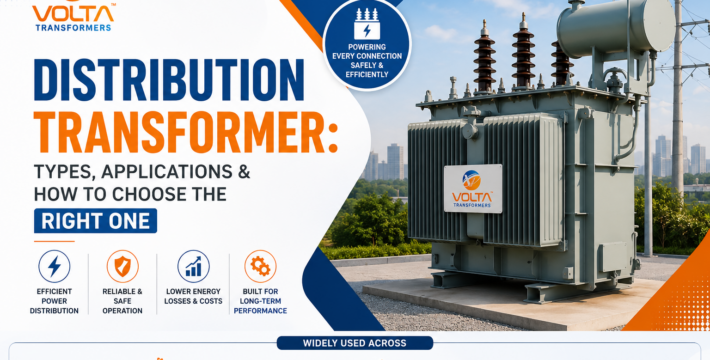
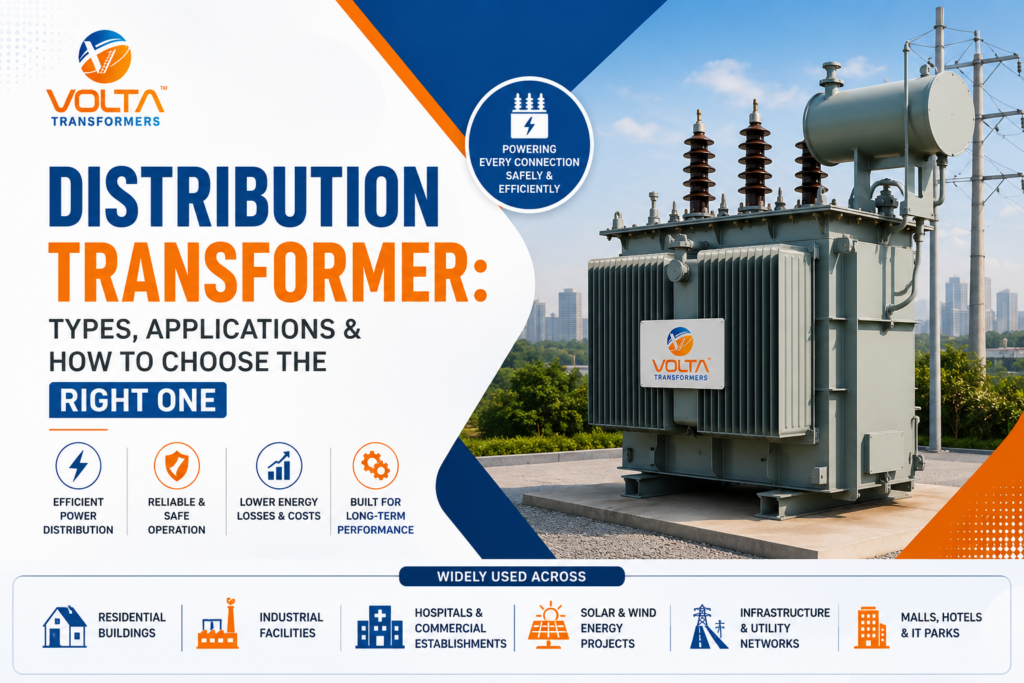
A distribution transformer is an electrical device used to reduce high voltage electricity to a lower, usable voltage for homes, commercial buildings, industries, utilities and infrastructure projects. It plays an important role in safe and efficient power distribution by delivering electricity at the required voltage level near the end-user point.
Choosing the right distribution transformer is important because it directly affects power reliability, energy efficiency, safety, maintenance cost and long-term performance. The correct transformer should match the load requirement, installation location, voltage rating, cooling method, safety standards and operating environment.
So What Exactly Is a Distribution Transformer?
It’s a step-down transformer — the last one in line before power reaches you. It takes in higher-voltage electricity from the distribution network and brings it down to something usable.
Power transformers do something similar, but earlier in the chain, out in transmission networks. Distribution transformers are the ones you’ll actually find near people — homes, offices, factories, hospitals, solar farms, you name it.
Worth clarifying: it doesn’t make electricity. It just adjusts the voltage so what’s already flowing can be used safely.
How Does It Work, Really?
Electromagnetic induction — that’s the short answer. Inside, you’ve got a primary winding and a secondary winding, both wrapped around a magnetic core.
Higher-voltage power hits the primary winding first. That creates magnetic flux in the core, which then transfers energy over to the secondary winding — and out comes electricity at a lower, usable voltage. When it’s designed well, you also get stable voltage and minimal losses along the way. When it’s not… well, that’s where problems start.
Types of Distribution Transformers
Single-Phase Transformer. Homes, farms, small shops, rural setups — anywhere the load doesn’t justify three-phase power.
Three-Phase Transformer. This is the one factories and hospitals lean on. Hotels too. Malls. Anything running motors, HVAC, or heavy equipment needs this kind of capacity.
Oil-Immersed Transformer. Oil does double duty here — insulation and cooling both. Common outdoors, in utility networks, industrial plants.
Dry-Type Transformer. Air instead of oil. You’ll find these indoors more often than not, especially where fire safety is a bigger concern — hospitals, schools, data centres, high-rises.
Pole-Mounted Transformer. Exactly what it sounds like. Saves ground space, shows up a lot in rural and residential networks.
Pad-Mounted Transformer. Sits on a concrete pad, enclosed in metal. You’ll see these in residential societies and commercial complexes with underground cabling.
Hermetically Sealed Transformer. The oil never touches outside air. Less moisture exposure, less oxidation — which tends to mean a longer service life and less upkeep.
Where Do They Actually Get Used?
Just about anywhere voltage needs stepping down before it reaches the final load — residential buildings, hospitals, hotels, malls, pharmaceutical plants, textile units, car manufacturing, steel and cement plants, mining operations, solar and wind installations, tunnels, highways, hydropower sites. The list keeps going, honestly.
Choosing the Right One — What Actually Matters
Start with the load. Not just today’s load, either — think ahead. Undersize it and you’ll deal with overheating or outright failure. Go too big and you’re overspending while running inefficiently. There’s a middle ground, and it’s usually worth the extra time to find it.
Match the voltage. Input and output both need to align with your network and your equipment. Get this wrong and you’re looking at damaged equipment, unstable operation, real safety risks.
Nail down the capacity. Measured in kVA or MVA, and the right figure depends on load type, demand patterns, diversity factor, growth plans. Volta Transformers, as an example, covers everything from 25 kVA up to 6 MVA.
Think about the site. Outdoor installations need weatherproofing, corrosion resistance, the right enclosure. Indoors, you’re dealing with ventilation, space constraints, noise limits, and stricter fire codes. That’s usually why dry-type ends up indoors and oil-immersed outdoors — not a hard rule, but a common one.
Don’t ignore cooling. Oil handles heat in oil-immersed units, air does it in dry-type ones. Which is right depends on your load, your site, and honestly how much maintenance you’re willing to sign up for.
Look past the price tag. Cheapest upfront doesn’t mean cheapest overall. These things run for years — small losses compound. Sometimes paying more for a low-loss unit saves you more down the line.
Pick your winding material. Copper or aluminium. Copper conducts better, lasts longer. Aluminium’s often cheaper, and can still work well in the right design. Let the spec decide, not just the price.
Check the safety features. Temperature sensors, pressure relief devices, a Buchholz relay — and make sure it’s tested against IS or IEC standards for insulation, temperature rise, load performance.
Think about who’s selling it. A manufacturer that offers real technical support, customisation, documentation — that matters more than people realize, especially when downtime starts costing money.
Mistakes That Keep Coming Up
Chasing the lowest quote. Forgetting about future load growth. Getting the voltage wrong. Skipping over cooling needs. Using an indoor unit outdoors (or vice versa). All avoidable, all common. Check the losses, the testing standards, the safety features, the support — before you sign anything.
Why Volta Transformers
Volta Transformers builds distribution units for commercial, industrial, utility, and infrastructure needs — single-phase, three-phase, oil-immersed, dry-type, copper or aluminium windings, customised to spec.
Their product brief points toward energy-efficient design, solid construction, in-house testing, and support built around different operating conditions.
Wrapping Up
At its core, a distribution transformer has one job — get electricity to you at a voltage you can actually use. But how it’s built and chosen affects a lot more than that: energy costs, equipment lifespan, power quality, how often things go down.
Before buying, walk through the load, voltage, capacity, site, cooling, efficiency, winding material, safety features, manufacturer support. Get it right, and you’re looking at fewer losses and a transformer that actually lasts.

Leave a Comment