

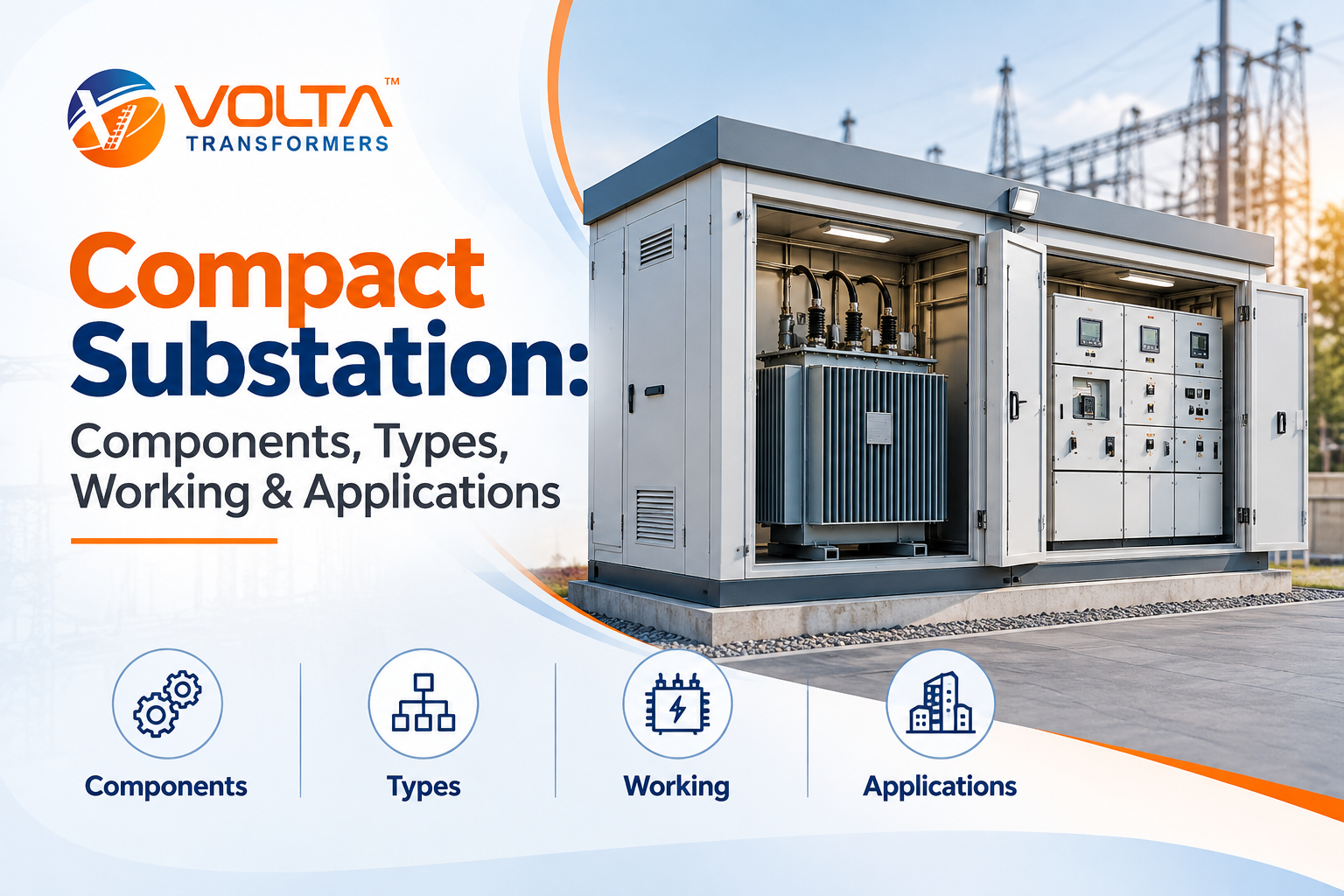
A compact substation is a ready-built power distribution unit. Medium-voltage switchgear, a transformer and a low-voltage panel sit inside one enclosure, and the manufacturer wires and tests the whole unit at the factory before it ships. Power arrives at medium voltage, the transformer steps it down, and it leaves at a level your equipment can actually use.
People choose these units for practical reasons: they take up less ground, need less work on site, and fit places where a full substation building won’t. This guide covers how they work, what’s inside, the main types, where they’re used and what to check before you buy.
What Is a Compact Substation?
It’s a type of prefabricated substation, sometimes also called a package substation, delivered as one complete unit. It takes power from a medium-voltage network, lowers the voltage, and passes it on to a building, factory or local network.
A conventional substation does the same job, but its equipment is spread out. The switchgear might sit in one room, the transformer outside on its own foundation and the low-voltage board somewhere else, with cables joining everything on site. In a packaged unit, by contrast, those pieces share one enclosure, and the manufacturer finishes the internal wiring before delivery. That’s where the smaller footprint comes from.
How Does It Work?
Follow the power through the unit and the sequence is simple.
- Supply arrives. A medium-voltage cable comes in from the utility or your own network.
- Switching and protection. The MV switchgear connects or isolates the supply, and opens the circuit if a fault appears.
- Transformation. The transformer brings the voltage down.
- Distribution. The LV panel splits the output into separate feeders, each with its own protection.
- Loads. Machines, lighting, ventilation and other equipment draw power from those feeders.
What Are the Main Components of a Compact Substation?
Medium-Voltage Switchgear
Think of this as the unit’s front door. Incoming cables terminate here, and in many units the switchgear is a ring main unit (RMU). From the switchgear, you can energise the transformer, switch it off, or isolate it so someone can work on it safely. Protective devices also trip the circuit on faults such as a short circuit or a heavy overload.
Compact Substation Transformer
The transformer does the actual voltage change. Two windings share one magnetic core: feed the primary, and a lower voltage appears on the secondary at the same frequency. In most designs, the compact substation transformer is a standard distribution transformer, selected for its capacity, voltage ratio and cooling method. Its kVA rating usually sets the ceiling for the whole unit.
Low-Voltage Panel
Once the voltage is down, power moves to the low-voltage panel and splits into outgoing feeders. Each feeder has its own breaker or fuse, so if one trips, the rest can usually stay on.
Protection and Metering Equipment
Protection is the part nobody notices until it works. Relays and fuses detect faults and isolate only the affected section. Surge arresters, meanwhile, protect the equipment from voltage spikes by diverting them to earth.
Metering is more of an everyday tool. The meters on the panel show what the unit is carrying, so a feeder that keeps running near its limit shows up long before anything trips.
Enclosure and Cable Connections
The enclosure does more than keep rain out. It holds the earthing, gives cables a proper way in, lets heat escape, and keeps people away from live parts behind lockable doors. Since layouts differ between manufacturers, check the arrangement against your project specification.
What Are the Different Types of Compact Substations?
Oil-Immersed Transformer Units
In these units, the core and windings sit in insulating oil, which also carries heat away. You’ll often see them outdoors and at higher capacities. However, they bring some planning work: oil containment, periodic oil checks, and fire-safety distances when buildings are close.
Dry-Type Transformer Units
A dry-type transformer uses solid insulation and air cooling, so there’s no liquid to leak or burn. For this reason, dry-type units are a common choice for indoor and fire-sensitive locations. Capacity and voltage limits depend on the design, so check those early.
Indoor and Outdoor Configurations
An outdoor unit needs a weatherproof, corrosion-resistant enclosure and enough airflow to shed heat. An indoor unit sits in an electrical room, where the enclosure can be simpler, but ventilation and maintenance access still matter. The right choice depends on the project’s electrical and environmental conditions.
What Are the Key Benefits?
Footprint is the headline benefit. Integrated equipment generally needs less room than a layout built piece by piece, and factory assembly leaves the site team with less to do. As a result, installation can be quicker, although foundations, cable routes and approvals still set the real timeline.
The enclosed design also protects the equipment and limits access to live parts. In addition, a packaged unit is easier to tie into the wider electrical system, and manufacturers can adapt configurations to the job. None of this happens automatically, though. Every benefit depends on specifying the unit properly.
Applications of Compact Substations
- Industrial and manufacturing plants: Placing the supply near heavy loads can shorten low-voltage cable runs.
- Commercial buildings: Many sites simply don’t have room for a full substation building.
- Residential developments: One unit can serve a cluster of buildings locally.
- Infrastructure projects: Pre-tested units suit projects that need several supply points on tight timelines.
- Renewable energy installations: At solar and wind sites, the unit typically steps the plant’s low-voltage output up to medium voltage for connection to the grid.
- Urban and space-constrained sites: Land is scarce and expensive, so a small footprint matters.
How Do You Choose the Right Compact Substation?
There’s no single right answer, but there is a sensible order of questions:
- Start with the load. Work out how much power you need, the incoming and outgoing voltage, and what equipment you’ll connect.
- Look at the equipment. Decide on the transformer type and your protection needs, and whether the unit will go indoors or outdoors.
- Check your space. Confirm the space you really have, and leave room for growth, because upgrading later is rarely cheap.
- Confirm compliance. Make sure the design meets the applicable electrical standards and your project specification.
A rough example shows how capacity works. A 400 kW load at 0.9 power factor is about 444 kVA. Add some margin for expansion, and you’d look at the next standard rating above that, such as 500 kVA. This is only an illustration, however. Real sizing also has to account for demand factors, motor starting, harmonics and ambient temperature.
Compact vs Conventional Substation
Factor | Compact | Conventional |
Space requirement | Smaller footprint, single enclosure | Larger area for separate equipment |
Equipment arrangement | Switchgear, transformer and LV panel in one unit | Separate items, flexible layout |
Installation | Mostly connected at the factory, less site work | Assembled and wired on site |
Factory integration | High; the whole unit undergoes testing as a package | Individual items tested; system integrated on site |
Application suitability | Space-limited sites, repeatable layouts | Large capacities, complex or bespoke designs |
Site requirements | Foundation, cable access, clearances | Larger site, civil works, building or yard |
Neither option is better across the board. Packaged units suit space-limited sites and repeatable layouts, while conventional substations remain the practical choice for large or highly customised installations.
Why Does Proper Selection Matter?
Choosing the right compact substation means weighing load demand, voltage, site conditions, safety, protection, reliability and future expansion together. If you get it wrong, you can end up with an overloaded transformer, weak protection or unplanned downtime. A qualified electrical engineer or the manufacturer can check these factors against your actual project, which is safer than relying on generic ratings.
Volta Transformers offers these units from 100 kVA to 4000 kVA, in 11 kV, 22 kV and 33 kV voltage classes, with low-voltage options from 380 V to 440 V. Cooling options include AN and ONAN, tap changers come in OCTC or OLTC versions, and customised configurations are available on request.
Frequently Asked Questions
What is a compact substation?
It’s a factory-built unit that puts medium-voltage switchgear, a transformer and a low-voltage panel into one enclosure. It brings medium voltage down to a usable level and feeds it to your loads, with a smaller footprint and less site assembly than a conventional substation.
What are the main components?
The main components are medium-voltage switchgear, a transformer, a low-voltage panel, protection and metering equipment, and an enclosure with cable connections.
What is a compact substation transformer?
It is usually a distribution transformer that steps medium voltage down to low voltage. It can be oil-immersed or dry-type, and engineers select its capacity, voltage ratio and cooling method to suit the load and the site. Its kVA rating generally sets the capacity of the whole unit.
What is the difference between a compact substation and an RMU?
An RMU (ring main unit) is medium-voltage switchgear on its own. A packaged unit, on the other hand, combines MV switchgear, a transformer and an LV panel in one enclosure, and that switchgear is often an RMU. In other words, an RMU can be one component inside the larger unit.
Oil-immersed or dry-type: which should I choose?
Oil-immersed units are common outdoors and at higher capacities. However, they need oil containment, periodic oil checks and fire-safety distances. Dry-type units avoid liquid altogether, which makes them a common choice indoors and in fire-sensitive locations. Either way, check the capacity and voltage limits of the specific design.
Where do these units work best?
infrastructure projects and renewable energy sites. They suit places where space is tight, or where a packaged, factory-tested unit is simpler than building a conventional substation on site.
Can you install one outdoors?
Yes. Manufacturers design many units for outdoor use, with weatherproof, ventilated enclosures that resist dust and moisture. Suitability depends on the design, the ingress protection (IP) rating and the local climate, so confirm the enclosure rating and site conditions with the manufacturer first.

Leave a Comment