


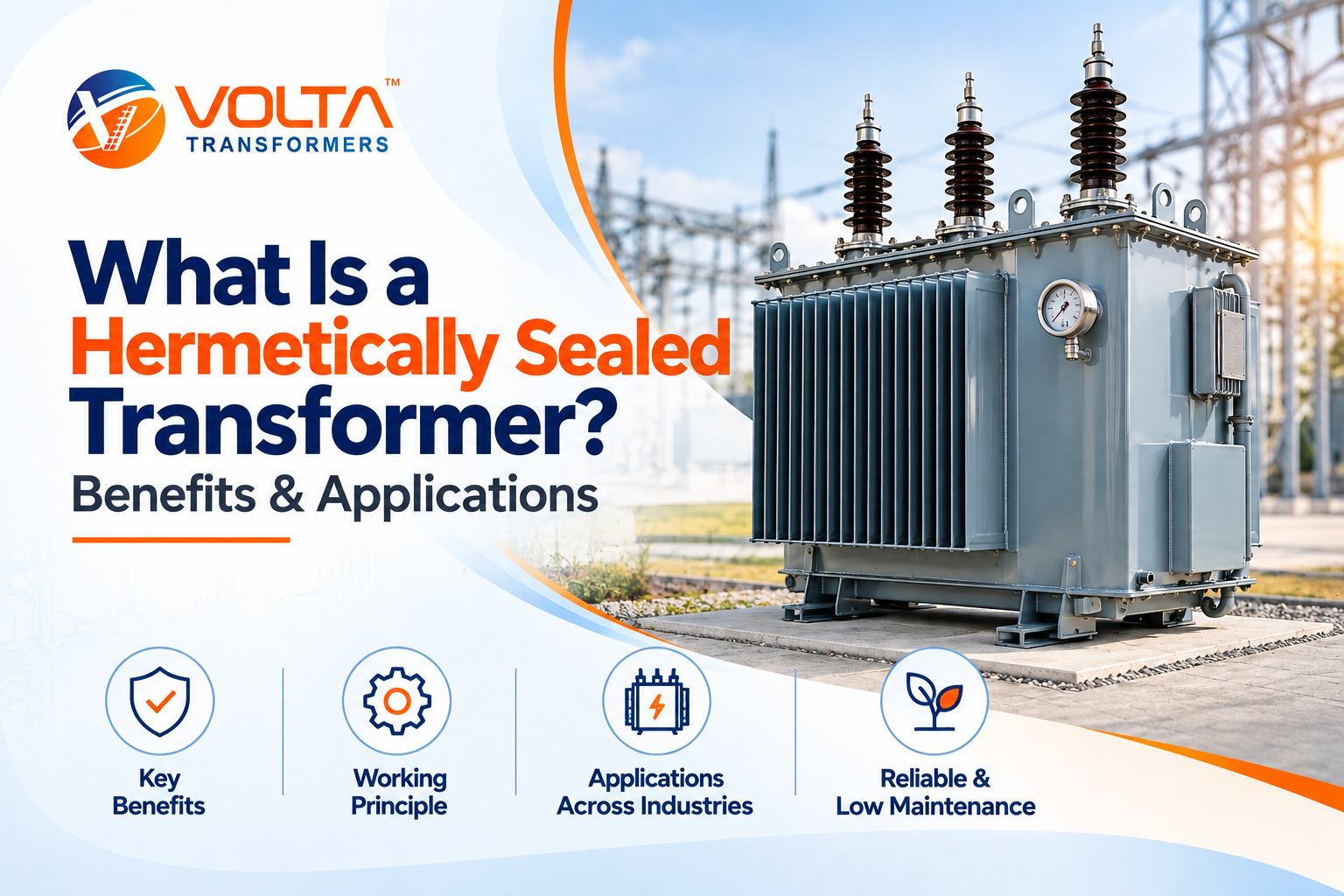
A hermetically sealed transformer is an oil-filled transformer whose tank stays completely closed, so the insulating oil never comes into contact with outside air. Unlike a conventional oil-immersed transformer, it has no conservator tank or breather. Instead, the tank itself, usually with corrugated walls, absorbs oil expansion and contraction as the temperature changes. Because it keeps air and moisture out, the design protects the oil and insulation. For this reason, these units are common in distribution networks, industrial plants, and dusty or humid locations.
What Is a Hermetically Sealed Transformer?
Think of it as an ordinary oil-filled distribution transformer with one big change: the manufacturer welds the tank shut, and it stays shut. Inside, you’ll find the same essentials as in any oil-immersed unit: a laminated steel core, high-voltage and low-voltage windings, and transformer oil surrounding all of it. What differs is how the tank holds that oil.
In a conventional design, a separate conservator tank above the main tank keeps the oil topped up. As the oil heats and cools, it moves in and out of the conservator, and the transformer “breathes” through a silica gel breather that dries the incoming air. A sealed transformer, by contrast, skips all of that. At the factory, the manufacturer fills the tank with oil, closes it and tests it for leaks. As a result, there is no conservator to install and no breather to look after.
So how does the oil have room to expand? In most designs, the tank walls consist of thin corrugated steel fins that flex outward as the oil warms and flatten as it cools. Alternatively, some designs leave a small cushion of nitrogen or dry air above the oil for the same purpose. Either way, the oil stays isolated from the atmosphere for the life of the unit.
That isolation is the whole point. Moisture and oxygen are the two things that degrade an oil-paper insulation system fastest, and a sealed tank limits both.
How Does a Hermetically Sealed Transformer Work?
The electrical working principle is the same as in any other transformer. In other words, the sealed tank changes how the unit stays cool and protected, not how it transforms voltage. Here is the sequence:
- Energy enters the primary winding. The AC supply connects to the high-voltage side through bushings on the tank.
- Electromagnetic induction takes over. The alternating current produces an alternating magnetic flux in the core. That flux then links with the secondary winding.
- The voltage changes. The turns ratio between the two windings sets the output voltage. For example, fewer turns on the secondary give a step-down transformer, which is what most distribution units are.
- Heat builds up. Core losses and winding losses are unavoidable, and they turn into heat while the transformer operates.
- Oil carries the heat away. Transformer oil circulates by natural convection, moving heat from the core and windings to the tank walls and radiator fins. From there, the heat dissipates into the surrounding air. The same oil also acts as the insulating medium between conductors at different potentials.
- The tank adapts to volume changes. As the oil heats up, it expands. The corrugated walls then flex outward to take up the extra volume, or the gas cushion compresses. Later, when the load drops and the oil cools, the walls pull back in.
- Outside air stays outside. Because nothing draws air in or pushes it out, the oil and insulation see far less oxygen and moisture than they would in a breathing design.
One practical consequence follows: the internal pressure of a sealed transformer rises and falls with oil temperature. This is normal. In fact, it’s the reason manufacturers design the tank for pressure variation and usually fit a pressure relief device for abnormal conditions.
Key Components of a Hermetically Sealed Transformer
Not every unit carries every item below. Ratings, manufacturers and applications all change the specification. Therefore, treat this as a map of what you are likely to see rather than a fixed parts list.
Commonly Present
- Magnetic core: Stacked laminations of grain-oriented electrical steel guide the magnetic flux. In addition, lamination keeps eddy current losses down.
- HV and LV windings: Copper or aluminium conductors wrap around the core limbs, with paper insulation, and sit immersed in oil.
- Transformer oil: Most units use mineral oil, although some manufacturers offer alternative insulating liquids. The oil both insulates and cools.
- Sealed tank with corrugated walls or radiators: The tank holds the active part and the oil. Meanwhile, the corrugations or attached radiators provide cooling surface and handle volume changes.
- Bushings: Porcelain or polymer insulators bring the high-voltage and low-voltage terminals through the tank wall.
- Pressure relief device: This opens if internal pressure rises beyond a set limit, for example during an internal fault.
Design-Dependent
- Temperature indicators: An oil temperature indicator is common. However, winding temperature indicators and alarm or trip contacts tend to appear on larger or more critical units.
- Tap changer: Many sealed distribution transformers use an off-circuit tap switch, which you operate only after de-energising the unit. On-load tap changers are possible in some designs, but they are not typical at lower ratings.
- Oil level or pressure gauges: Some manufacturers fit these, while others leave them out.
- Drain and sampling valves: Provision for oil sampling also varies with design.
If you’re familiar with larger transformers, one point is worth knowing. Engineers normally associate a Buchholz relay with conservator-type units. As a result, a sealed transformer relies on other protection, such as a pressure relief device, temperature devices and upstream electrical protection. Some sealed units also use an integrated protection relay, sometimes called a DGPT2 relay, which monitors gas, pressure, temperature and oil level in one device.
What Makes a Transformer “Hermetically Sealed”?
“Hermetic” means airtight, and that is the defining feature. A few characteristics separate a true sealed design from a conventional one:
- Airtight tank. The manufacturer welds the tank closed and uses gaskets only where a joint is unavoidable. In addition, a pressure or leak test typically confirms the seal during manufacturing.
- No contact with atmospheric air. The oil surface does not touch outside air at any point during normal operation.
- Prevention rather than management. Conventional units use a breather to dry incoming air. A sealed design, however, aims to prevent moisture ingress by stopping the exchange of air altogether.
- Reduced oxidation and contamination. With little oxygen and no airborne dust entering, the oil ages more slowly than it would in an open-breathing system, all else being equal.
- Controlled pressure and expansion. The flexible tank walls or gas cushion deal with thermal expansion inside a closed volume.
- No conservator or breather. This is the visible difference. Where a conventional transformer has a drum on top and a silica gel jar on the side, a sealed one has neither.
Still, “hermetic” describes the design intent. It does not mean a unit can never leak or that its internal condition never needs checking, which we come back to below.
Benefits of Hermetically Sealed Transformers
Reduced Moisture and Air Exposure
Water is the enemy of oil-paper insulation. Even small amounts lower the dielectric strength of the oil and speed up the breakdown of cellulose paper. In a breathing transformer, moisture can enter through a saturated breather or a poorly maintained seal. A closed tank, therefore, takes most of that risk off the table.
Lower Oxidation of Transformer Oil
Oxygen reacts with hot mineral oil and forms acids and sludge. These by-products reduce the oil’s cooling ability and attack the insulation. With less oxygen available, however, oxidation proceeds more slowly. That does not stop oil ageing, since heat and electrical stress still play their part, but it removes one major driver.
Reduced Maintenance Requirements
No conservator means no conservator oil level to monitor. Similarly, no breather means no silica gel to replace and no saturated breather to worry about. For utilities and facilities that manage many distribution transformers across a wide area, removing these recurring tasks adds up. Reduced is the operative word, though, not eliminated.
Compact and Practical Design
Without a conservator on top, the overall height is lower. This can help in compact substations, enclosures or sites with limited vertical clearance. Fewer external accessories also mean fewer fittings that could suffer damage during transport or handling.
Improved Protection of Insulation
Insulation condition has a close link to transformer reliability. By limiting moisture and oxygen, a sealed design helps the insulation system keep its properties for longer under normal operating conditions. However, overloading, high ambient temperatures and poor-quality oil can still shorten that. In other words, the sealed tank is a protective factor, not a guarantee.
Suitable for Harsh or Dusty Environments
Dust, salt-laden air, high humidity and industrial pollutants can all find their way into a breather system. Sealed construction, on the other hand, keeps them away from the oil. Typical examples include coastal areas, cement and textile plants, and regions with heavy monsoons. External surfaces still need proper corrosion protection, though. After all, a sealed tank is only as good as its paint and welds.
Longer Service Life Potential
Because the oil and insulation degrade more slowly, a hermetically sealed transformer has the potential for a longer working life. Actual life, however, depends on loading, temperature, manufacturing quality, installation and upkeep, so no single lifespan figure applies across the board. For this reason, ask the manufacturer what service life the design targets and what the warranty covers.
Hermetically Sealed Transformer vs Conventional Oil-Immersed Transformer
Neither design is better in every situation. The table shows how they generally differ, although details vary by manufacturer and rating.
Feature | Sealed Transformer | Conventional Oil-Immersed Transformer |
Tank design | Fully sealed tank, often with corrugated walls or radiators that flex with oil volume | Tank connected to a conservator, usually with plain or radiator-type walls |
Exposure to atmosphere | Oil stays isolated from outside air in normal operation | Air reaches the oil indirectly through the breather |
Conservator | Not used | Used, especially on larger ratings |
Breather arrangement | None | Silica gel breather to dry incoming air |
Moisture exposure | Low, as long as the seal remains intact | Higher; depends on breather condition and oil level |
Oil oxidation | Generally slower due to limited oxygen contact | Can be faster if air contact is not well controlled |
Maintenance requirements | Fewer routine tasks; inspection still needed | Periodic checks of conservator level, breather and oil condition |
Typical applications | Distribution networks, industrial and commercial sites, harsh environments | Wide range, including large power transformers and substations |
Installation considerations | Lower overall height; check clearance for corrugated fins and rated pressure behaviour | Needs space for the conservator and access for breather servicing |
Large power transformers, for instance, often still use conservators. This is because the oil volume, the need for on-load tap changers and Buchholz protection suit that arrangement. Sealed designs, by contrast, tend to dominate in the distribution range.
Applications of Hermetically Sealed Transformers
- Industrial facilities and manufacturing plants: Dust, vibration and variable loads are routine. A closed tank keeps contaminants away from the oil, and fewer accessories also mean fewer parts to service on a busy shop floor.
- Commercial buildings: Where transformers sit in basements, podiums or compact substations, the lower profile and reduced upkeep help.
- Infrastructure projects: Projects such as metro systems, airports and campuses may use many identical units. As a result, standardised, low-attention transformers simplify long-term management.
- Distribution networks and utility applications: Utilities often manage large fleets of pole-mounted and pad-mounted transformers. Therefore, reduced routine servicing per unit is a real operational advantage.
- Renewable energy installations: Solar plants and wind farms often sit in remote or exposed locations. Sealed tanks suit sites where regular visits are expensive and dust or humidity is a concern.
- Rural and semi-urban power distribution: Long feeders, limited maintenance crews and dusty conditions are the standard picture. In this setting, a transformer without a breather is one less thing to go wrong in the field.
- Areas with dust, humidity or contaminants: Coastal, desert and industrial-belt locations benefit from the isolation of the oil, provided the tank has a suitable anti-corrosion coating.
Factors to Consider Before Choosing a Sealed Transformer
If you are specifying or evaluating one, go through this list with your manufacturer or consultant.
- Rating (kVA): Size for the present load plus a realistic allowance for growth. However, avoid drastic oversizing, since no-load losses apply all the time.
- Voltage ratio: Confirm the primary and secondary voltages, as well as the tapping range you need to cope with supply variation.
- Frequency: India and the UK usually use 50 Hz, while some other markets use 60 Hz. Confirm it matches your system.
- Cooling: Distribution units typically use natural oil cooling (ONAN). Check what the rating and ambient conditions require.
- Installation environment: Indoor or outdoor siting, altitude, humidity, pollution level and corrosion risk all affect the tank finish and design.
- Ambient temperature: High ambient temperature reduces loading capacity. Therefore, make sure the temperature rise limits suit your site.
- Load profile: Steady, cyclic and harmonic-rich loads stress a transformer differently. For this reason, mention nonlinear loads such as drives and rectifiers up front.
- Short-circuit requirements: The transformer must withstand the fault levels of your network, both thermally and mechanically.
- Insulation level: Match the basic insulation level (BIL) and withstand voltages to your system and its exposure to surges.
- Efficiency: Compare no-load and load losses from the manufacturer’s test data and relevant efficiency classes, rather than general claims.
- Applicable standards: Common references include IEC 60076 for power transformers and, in India, IS 1180 for distribution transformers and IS 2026 for power transformers. Other regions apply other standards, such as the IEEE C57 series. In any case, check which edition applies, and ask for test reports instead of assuming compliance.
- Protection requirements: Decide on pressure relief, temperature alarm and trip devices, and upstream protection.
- Maintenance expectations: Ask what inspection routine the manufacturer recommends and who will carry it out.
- Manufacturer’s technical specifications: Datasheets, type test reports and guaranteed technical particulars are what count. Since design details differ from one manufacturer to another, review these documents rather than relying only on general product claims.
Are Hermetically Sealed Transformers Maintenance-Free?
No. They need less routine maintenance, not none. Although the sealed design removes conservator and breather upkeep, the transformer is still electrical equipment working under heat and stress for years.
A sensible routine usually includes:
- Regular visual inspection of the tank, fins, paintwork and surroundings
- Checking bushings for cracks, tracking or dirt build-up, and connections for looseness or discolouration
- Monitoring oil and winding temperature readings where the unit has indicators
- Listening for abnormal humming or noise, and noting any overheating
- Looking for oil leaks, bulging beyond normal, or physical damage
- Following the manufacturer’s maintenance schedule and any utility or site requirements
Anything beyond external inspection, such as oil sampling, testing or work on terminals, needs qualified personnel. They should follow the site’s safety procedures and work only after de-energising and isolating the equipment. Finally, never open a sealed tank in the field.
Conclusion
A hermetically sealed transformer is an oil-filled unit with a closed tank that keeps the insulating oil away from outside air. This sealed construction limits moisture and oxygen, the main causes of oil and insulation degradation. It also removes the conservator and breather found on conventional designs. As a result, the transformer typically needs less routine attention, suits dusty or humid sites and fits well in distribution applications.
Even so, it is not a maintenance-free machine, and it is not the right answer everywhere. The better question is which design suits your load, voltage, environment and standards. Therefore, compare manufacturer specifications carefully, and let the application and installation conditions guide your choice.
What does “hermetically sealed” mean for a transformer?
It means the transformer tank stays completely closed. The insulating oil has no contact with outside air, and there is no conservator or breather. Instead, flexible tank walls or an internal gas cushion absorb oil expansion. As a result, the design limits moisture and oxygen exposure, which helps protect the oil and insulation.
How does a sealed transformer work?
Like any other transformer, it works by electromagnetic induction. Current in the primary winding creates flux in the core, which then induces a voltage in the secondary. The sealed tank affects only the oil system: the oil insulates and cools the active part, while the tank accommodates thermal expansion without letting air in.
What is the difference between a hermetically sealed and conventional transformer?
A conventional oil-immersed transformer usually has a conservator and a silica gel breather, so air reaches its oil indirectly. A sealed transformer has neither, and its tank stays closed. Therefore, the sealed type generally needs less routine upkeep, while conventional types remain common at higher ratings.
Does a sealed transformer have a conservator tank?
No. This design does not use a conservator. Instead, the tank design itself gives the oil room to expand and contract, through corrugated walls or radiators that flex, or a sealed gas cushion above the oil. In addition, this removes the need for a breather.
What are the benefits of a hermetically sealed transformer?
The main benefits include reduced moisture and air exposure, slower oil oxidation, better insulation protection and fewer routine maintenance tasks. The design can also be lower in height, and it suits dusty or humid sites. However, the benefits depend on good manufacturing, correct loading and proper installation.
Are sealed transformers maintenance-free?
No. They need less maintenance, not zero. For example, you still need visual checks, inspection of bushings and connections, temperature monitoring and leak checks. It’s also important to follow the manufacturer’s maintenance schedule, and only qualified personnel should handle work beyond external inspection.
Where do you use a hermetically sealed transformer?
Common uses include power distribution networks, industrial plants, commercial buildings, infrastructure projects and renewable energy sites. They also suit rural and semi-urban feeders, as well as locations with dust, humidity or contaminants, where regular servicing of conservators and breathers is inconvenient.
Does a sealed transformer use transformer oil?
Yes. It is an oil-filled transformer, and the oil serves two purposes: electrical insulation and cooling. Mineral oil is the most common choice, although some manufacturers use other insulating liquids. The only difference from a conventional unit is that the oil stays in a closed system, away from outside air.

Leave a Comment