
Every transformer does the same basic job of moving electrical energy from one circuit to another, usually while changing the voltage along the way. But the transformer sitting on a substation floor has almost nothing in common, physically, with the one bolted inside a steel mill’s furnace bay. That’s the reason transformers get sorted into types in the first place. Understanding the types of transformers available, and what each one is actually built for, is the difference between specifying equipment that fits your system and specifying something that technically “works” but was never meant for the job.
What Is a Transformer?
The short version: a transformer transfers electrical energy between circuits using electromagnetic induction, with no direct electrical connection between the primary and secondary windings. Current flows through the primary winding, that current builds a changing magnetic field in the core, and the field induces a voltage in the secondary winding. Change the ratio of turns between the two windings and you change the voltage step it up, step it down, whichever the application calls for. It sounds almost too simple for something so central to how power gets delivered. But that simplicity is exactly why it works at scale. Generation stations produce power at one voltage, step it up for the trip across transmission lines (high voltage loses less energy over distance), then step it down again, sometimes several times, before it reaches a building. Skip any of those steps and the system doesn’t function the way we expect it to. None of this requires moving parts, which is part of why transformers are so durable compared to other heavy electrical equipment. There’s no motor spinning, no mechanical wear from the core process itself – the losses and stress come mostly from heat, load cycling, and environmental exposure. That’s also why so much of transformer design ends up being about managing those factors rather than the induction principle itself, which hasn’t really changed in over a century.How Are Transformers Classified?
There isn’t one “correct” way to categorize transformers; it depends on which question you’re trying to answer. Common classification methods include:- Application – the transformer’s role within the power system
- Voltage level – step-up, step-down, or isolation at matching voltage
- Construction – core-type versus shell-type
- Phase – single-phase or three-phase
- Cooling method – dry-type, oil-immersed, forced-air, and so on
- Installation environment – indoor, outdoor, pad-mounted, pole-mounted, underground
Types of Transformers Based on Application
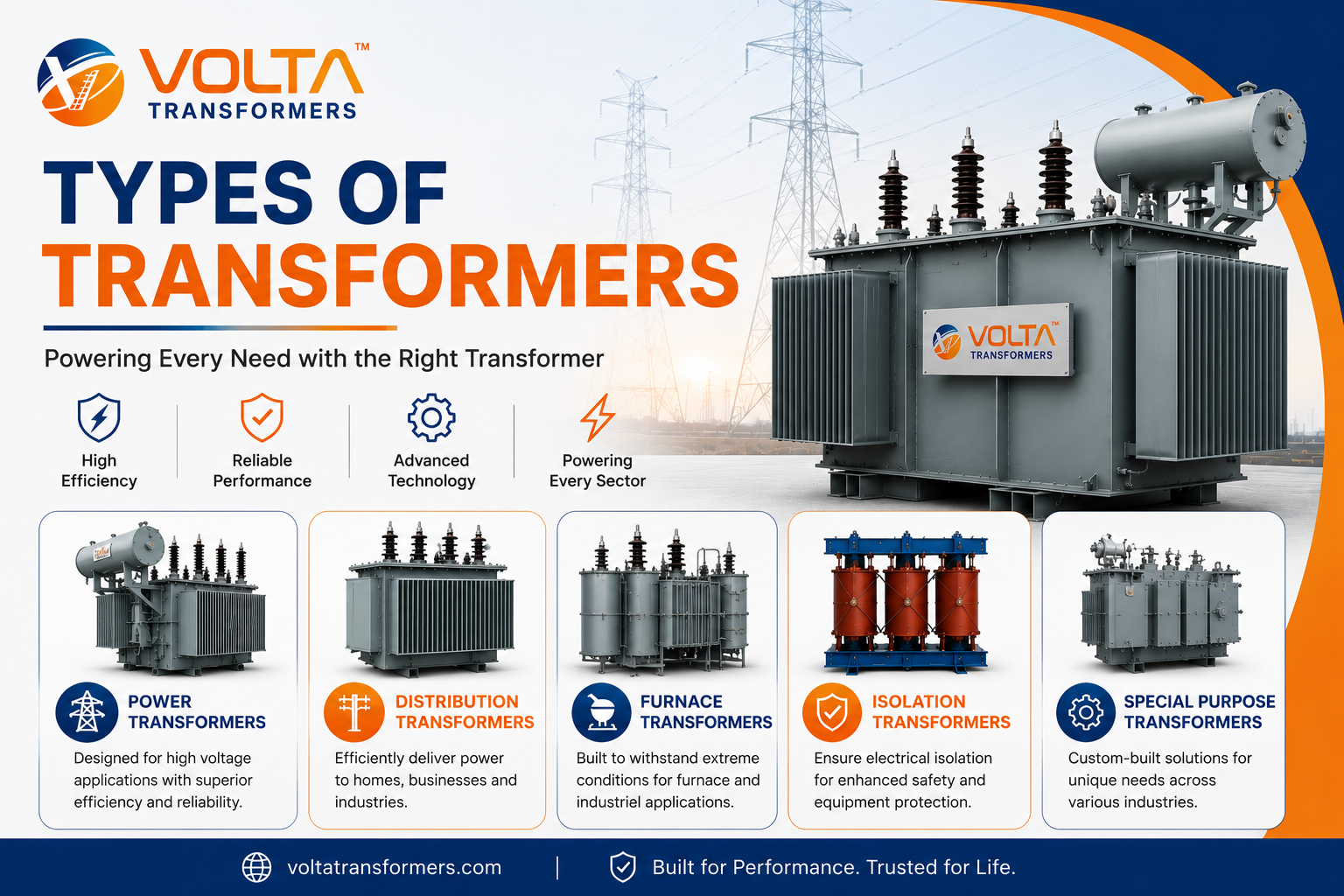
Here’s where the real differences show up. A few of these categories blur into each other a distribution transformer is, by function, also a step-down transformer so don’t treat this list as eight hard, non-overlapping boxes. Think of it more as eight common roles a transformer might be asked to fill.Power Transformers
These live at generating stations and transmission substations, handling the heavy lifting of stepping voltage up for transmission or down at the receiving end. They’re built for steady, near-constant loading rather than the up-and-down demand you’d see closer to consumers. Given the voltages and power levels involved, power transformers tend to be some of the largest pieces of equipment in the entire grid.Distribution Transformers
Once power reaches the distribution side of the grid, distribution transformers take over stepping medium voltage down to something usable in homes, offices, retail spaces, and smaller industrial sites. Unlike power transformers, these have to handle loads that swing constantly through the day. Most people have actually seen one of these without realizing it: the gray can on a utility pole, or the green box on a concrete pad in a parking lot.Furnace Transformers
Electric arc furnaces and induction furnaces, common in steel and metal processing, need enormous current at comparatively low voltage and they need it while absorbing constant electrical disturbance from arcing. That combination is hard on standard transformer construction, so furnace transformers get reinforced windings, heavier insulation, and other design choices you won’t find on a general-purpose unit.Rectifier Transformers
Rectifier transformers feed systems that convert AC to DC, which shows up in electroplating, electrolysis, and similar electrochemical processes. The catch is that rectifier loads push harmonics and non-linear current back into the transformer, and that stress has to be accounted for in the design otherwise you get excess heating and lost efficiency over time.Isolation Transformers
Not every transformer exists to change voltage. Isolation transformers separate the primary and secondary circuits electrically, mainly for safety and to keep noise or transient disturbances from one circuit bleeding into another. You’ll find these protecting sensitive electronics, lab instruments, and medical equipment anywhere a disturbance on the main supply could cause real problems downstream.Special-Purpose Transformers
A handful of applications are specific enough that they warrant their own transformer design entirely. Railway traction transformers are one example; instrument transformers used for metering and protection are another. These tend to be built to a much narrower spec than general power or distribution units, because the application leaves less room for compromise.What Are the Main Types of Transformers?
Boiled down: power, distribution, industrial, furnace, rectifier, isolation, earthing, and special-purpose transformers cover the main application-based categories. Each corresponds to a specific stage or need within the power system, from bulk transmission down to a narrow industrial process.Application-Based Comparison
| Transformer Type | Primary Application | Typical Use / Industry |
|---|---|---|
| Power Transformer | Step-up/step-down for transmission | Generating stations, transmission substations |
| Distribution Transformer | Step-down to consumer-usable voltage | Residential, commercial, light industrial |
| Furnace Transformer | High-current supply for electric furnaces | Steel and metal processing |
| Rectifier Transformer | Supplying AC-to-DC rectifier systems | Electrochemical and industrial DC processes |
| Isolation Transformer | Electrical isolation and safety | Sensitive electronics, medical, lab equipment |

Leave a Comment