
Introduction
In the context of electrical power distribution systems, transformers play a vital role in maintaining voltage levels and ensuring stable energy transmission. When it comes to selecting a transformer for industrial, commercial or infrastructure projects, one of the most common choices engineers will make is between dry type transformers and oil filled transformers.
There are important differences between these two technologies, and understanding them can play an integral role in choosing the right technology for specific applications. Selection of transformers varies with the installation environment, safety criticality, maintenance requirement and operation efficiency etc. Understanding the comparison between dry type vs oil filled transformer which includes their design, advantages and best usage helps organizations choose the most effective solution for their electric system.
Thus, to make the decision easier for businesses when it comes to their power distribution needs, this article reveals major differences between dry type and oil filled transformers.
Understanding Dry Type Transformers
Dry type transformers cool and insulate with air or solid insulation instead of oil. These are transformer designs that do not require liquid insulating materials, and are thus free from the associated risks.
Dry-type transformers are safer for indoor installations and where fire safety is a primary concern as they do not use oil. Several new electrical systems utilize dry type transformers that minimize both environmental risk and make more reliable performance.
Dry type transformers are usually found in following installations:
- Commercial buildings
- Hospitals
- Data centers
- Shopping malls
- Indoor industrial facilities
As they provide a small footprint and improved safety, it makes them applicable in places where environmental protection and fire safety matters.
Understanding Oil Filled Transformers
Insulating oil is used for cooling and electrical insulation in oil filled transformers. The oil in the transformer helps dissipate heat while operating.
These are used extensively in large industrial premises and outdoor electrical installations as oil has good cooling properties and high insulating strength.
Oil-immersed transformers are usually positioned in:
- Outdoor substations
- Power plants
- Heavy industrial facilities
- Utility power distribution networks
These are legendary for providing significant volume and maintaining speed, even when pushed hard.
Key Differences Between Dry Type and Oil Filled Transformers
Transformers
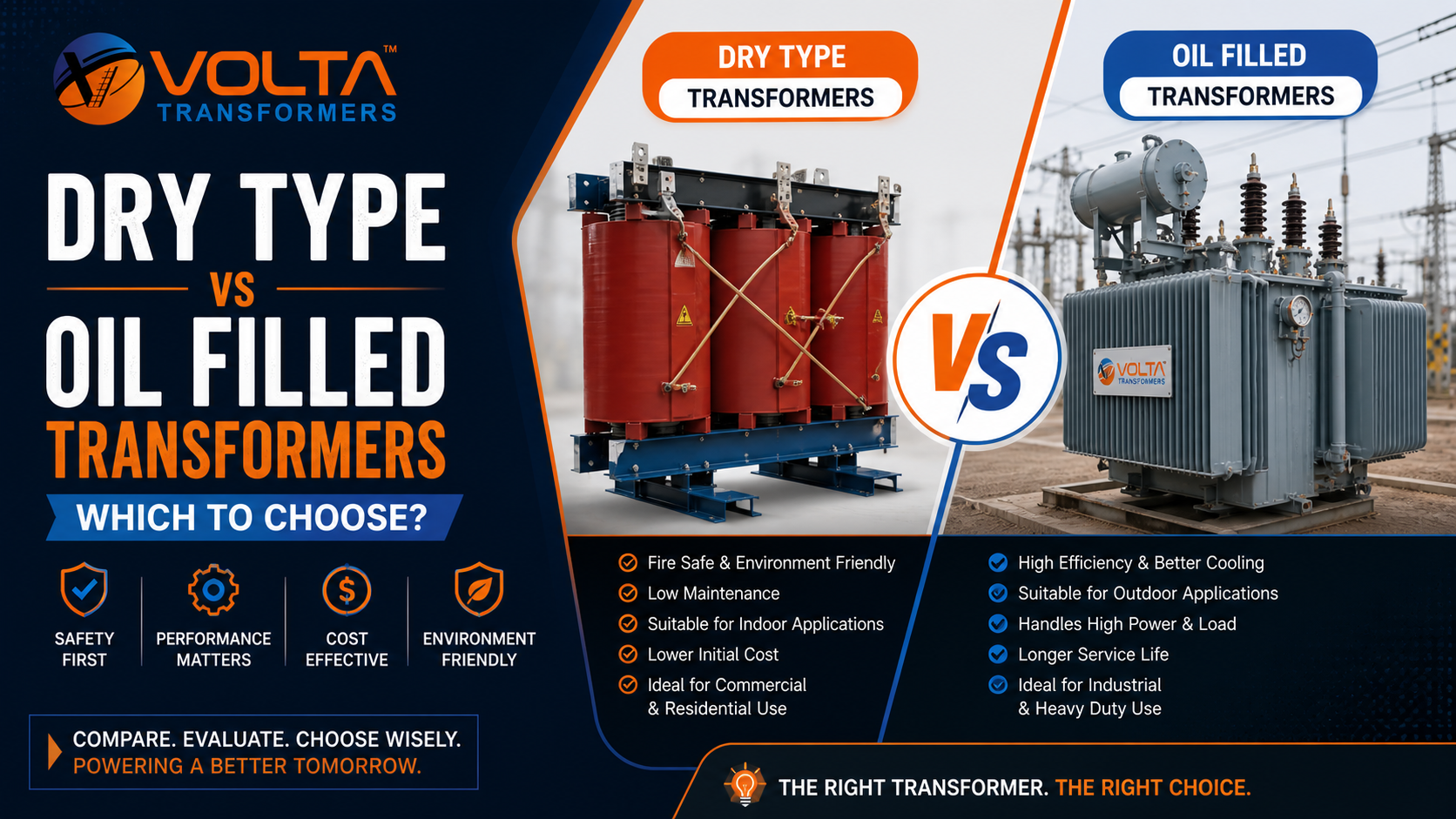
Knowing the technical differences between the two transformer types enables better assessment of dry type vs oil filled transformer for specific applications.
Cooling Method
Vice versa, the dry type transformers are cooled by air circulation or solid insulation systems. Some fans or passive air flow keep the temperature within safe operating ranges.
The oil inside the transformer tank is insulating oil and provides better heat absorption and dissipation as it circulates.
Safety and Fire Risk
Dry type transformers do not use oil which is flammable, hence it has higher level of safety. Especially, this helps to minimize any risk of fire and makes them suited for indoor settings.
Transformer oil is used as an insulator in oil-filled transformers; however, storage and use of transformer oils can be a fire hazard, particularly in cases of leaks or faults. As a result, they are usually located outside or in separate transformer compartments.
Maintenance Requirements
The two transformer types have different maintenance needs.
They do not require oil testing or oil replacement processes, hence requiring relatively minimal maintenance.
Maintenance activities such as the following are required for oil-filled transformers:
- Oil testing
- Oil filtration
- Leak inspection
- Cooling system checks
In addition, there are many other maintenance items that help improve the insulation function of your unit as well as cooling efficiency.
Installation Location
Dry type transformers are more suitable for indoor installations when safety and environmental protection issues are important.
Therefore oil basked transformers are often kept outdoors where the temperature is not great but requires clearances for cooling and safety.
Dry type vs oil filled transformer installation location is an important factor in choosing the best option.
Efficiency and Load Capacity
Under heavy load conditions, oil filled transformers (OFT) significantly outperform dry type transformers (DPT) with regards to efficiency and cooling. They are commonly found in high capacity electrical distribution systems.
High-frequency transformers, primarily dry type, are used for medium-capacity applications.
Advantages of Dry Type Transformers
Dry type transformers provide a plethora of benefits in contemporary electrical systems:
- Less risk of fire, because there’s no oil
- Environmentally friendly design
- Lower maintenance requirements
- Ideal for indoor installations
- Compact and easy installation
Thus dry type transformers are ideal for commercial buildings and sensitive environments.
Advantages of Oil Filled Transformers
There are also few operational advantages that oil filled transformers offer:
- High load capacity
- Efficient cooling performance
- Reliable operation in outdoor environments
- Suitable for heavy industrial applications
They are built to deal with high electrical load and severe styles of working situations.
Factors to Consider When Choosing a Transformer
Choosing the proper transformer involves multiple technical and environmental factors.
Engineers should evaluate:
- Installation environment
- Load capacity requirements
- Safety regulations
- Maintenance capabilities
- Available installation space
This among many others is the crucial decision-making factor for organizations that guides them whether a dry type transformer suits their electrical infrastructure or an oil filled transformer does.
Conclusion
Dry Type Vs Oil Filled Transformer — which one to choose? Transformer benefits are unique to each type making them viable for a variety of applications.
Dry type transformers are best suited for indoor applications, especially where fire safety and environmental concerns are of high importance. Alternatively, oil filled transformers offer higher load capacity and effective cooling for outdoor-based and heavy industrial applications.
The selection of appropriate solution for power distribution systems among dry type vs oil filled transformer options ensures reliability, safety and operational efficiency over time.

Leave a Comment