

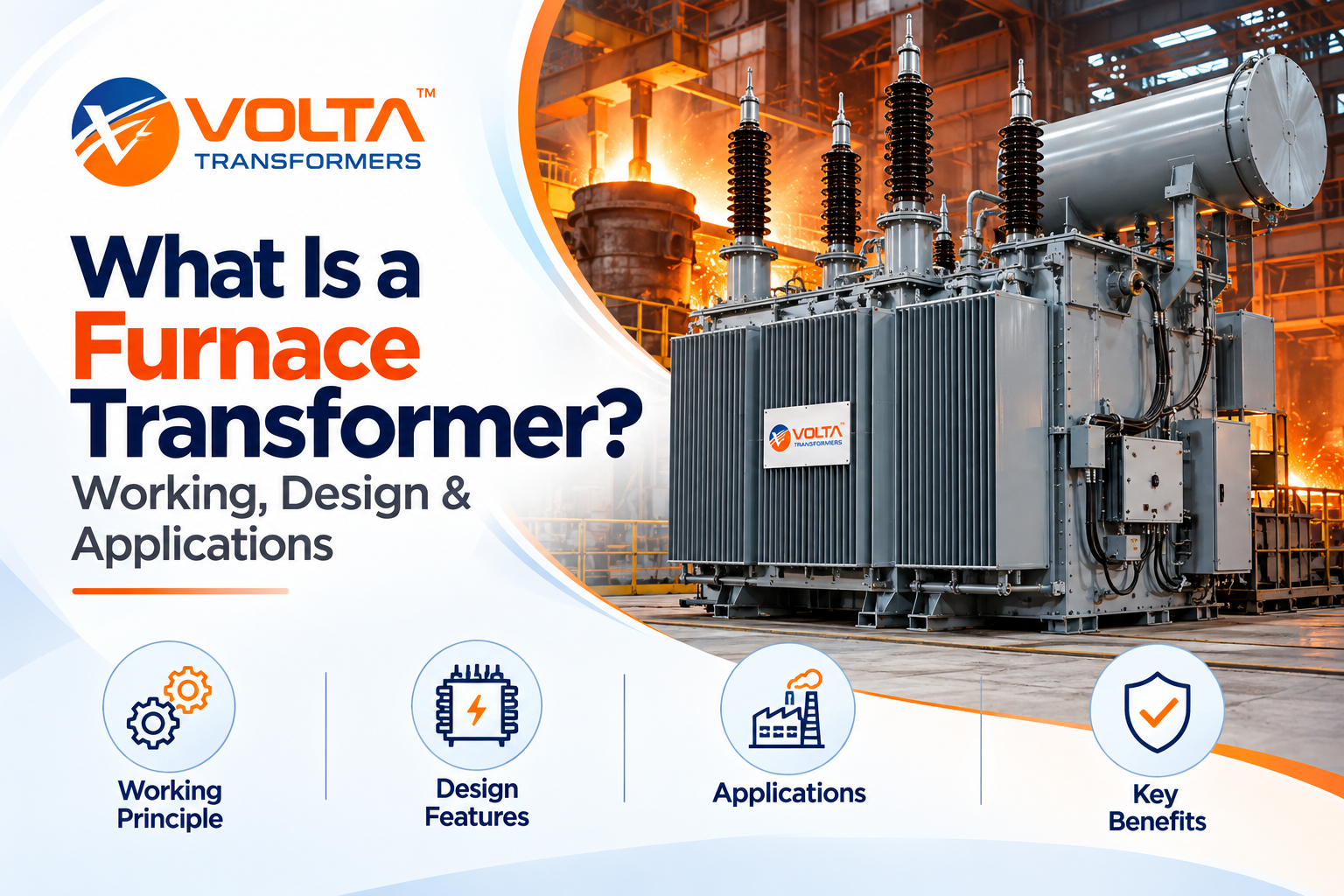
An electric furnace is a hungry load. Melting a charge of scrap steel can draw several megawatts or more at only a few hundred volts, which means thousands of amperes. On top of that, the draw never stays steady. So, what is a furnace transformer? It is the unit between the power grid and an electric furnace. It steps the voltage down, delivers that heavy current, and survives the heat and shocks that come with it. Below, we cover how it works, what’s inside, where it’s used and how to choose one.
What Is a Furnace Transformer?
A furnace transformer is a specialised step-down transformer that feeds electric arc furnaces and induction furnace systems with low-voltage, high-current power.
The physics is the same as in the transformer on your street corner, but the job is very different. A distribution transformer serves many small, fairly predictable loads. By contrast, a furnace transformer serves one enormous load that keeps changing. In an arc furnace, scrap collapses, electrodes touch the charge, the arc stretches and shrinks, and the current jumps. As a result, the transformer has to absorb that shift after shift.
The numbers explain the design. For example, a 10 MVA unit with an 800 V secondary pushes roughly 7,200 A per phase. At that level, every joint, conductor and brace matters. Even so, the exact requirements depend on the furnace type and how the plant runs it.
Furnace Transformer Working Principle: How Does It Work?
The furnace transformer working principle is plain electromagnetic induction:
- AC power enters the primary winding, typically at 11, 22 or 33 kV.
- The current then sets up an alternating magnetic flux in the core.
- That flux links the secondary winding and induces a voltage in it.
- Because the secondary has far fewer turns, the output voltage is low and the available current is high.
- Finally, a tap changer, where fitted, changes the turns ratio so operators can pick a suitable voltage.
Nothing here creates energy. Power in roughly equals power out, minus losses. In other words, the transformer trades voltage for current. In arc furnaces, operators also move between taps during a heat. Depending on their practice, they often use a higher voltage while melting and a lower voltage during refining.
Furnace Transformer Design and Key Components
The exact build depends on the rating, the furnace technology and the manufacturer’s design. However, these are the parts that matter most:
- Core: Grain-oriented steel laminations carry the flux with low losses.
- Windings: The high-voltage side uses many turns of finer conductor. The low-voltage side, on the other hand, uses a few turns of heavy, often multi-strand conductor to handle the current.
- Insulation and cooling: In oil-filled units, oil and paper insulate the windings and also carry heat away. Common cooling methods include ONAN (oil natural, air natural), ONAF (oil natural, air forced), OFAF (oil forced, air forced), and water-cooled options such as ONWF and OFWF. For a wider comparison of insulation types, see our guide to dry type vs oil-filled transformers.
- Tap changer: An on-load tap changer (OLTC) adjusts the voltage without stopping the furnace. Meanwhile, an off-circuit tap changer (OCTC) suits occasional adjustment.
- Bushings and connections: Low-voltage bushings and busbars carry huge currents, so a poor joint here will overheat.
- Protection: Typical arrangements include protective relays, temperature indicators, surge arresters and cooling-fan controls. Oil-filled units also commonly use a Buchholz relay and a pressure relief device.
Short-circuit withstand deserves special mention. Furnace duty produces repeated fault-like events. For this reason, the windings need rigid bracing as well as good electrical ratings.
Types of Furnace Transformers
Electric Arc Furnace Transformers
These units power steelmaking and metal melting. They run at very high secondary currents and need a range of voltage steps. In addition, they must cope with a constantly changing arc.
Induction Furnace Transformers
These units feed induction melting systems. Many medium-frequency installations use a rectifier and an inverter between the supply and the furnace coil, so the transformer must suit that converter equipment. Some designs also use multiple secondary windings to reduce harmonics. Other induction furnaces work differently, however, so always follow the furnace maker’s electrical data.
Neither type is interchangeable with a general-purpose unit of the same kVA. Our guide to types of transformers based on application shows how duty shapes design.
Furnace Transformer Applications
Furnace transformer applications cover any process that turns electricity into controlled heat:
- Electric steelmaking: EAF plants melt scrap with extreme currents, so they need stable, adjustable power through every stage. Steel is one of the industries we serve.
- Foundries: Induction furnaces melt iron, steel and alloys in batches, so frequent start-stop duty matters.
- Non-ferrous processing: Copper, brass and aluminium melting needs steady, controllable power. Large-scale aluminium smelting, by contrast, normally uses rectifier transformers, which are a separate category.
- Refining and heat treatment: Consistent temperatures depend on a well-matched supply.
Still, not every unit suits every application, because the furnace’s electrical design sets the requirements.
Furnace Transformer vs. Distribution Transformer
Factor | Furnace Transformer | Distribution Transformer |
Load | Concentrated, cyclic, variable | Mixed, generally steadier |
Secondary side | Low voltage, very high current | Standard utilisation voltage |
Fault stress | Frequent, severe in arc furnaces | Occasional |
Cooling and protection | Often forced cooling, more monitoring | Often natural cooling, standard protection |
These differences also vary with the equipment and duty cycle. For more on the other side of the table, read our guide to distribution transformer types and applications.
How to Choose the Right Furnace Transformer
First, start with the furnace manufacturer’s electrical requirements. Then confirm them with a qualified engineer, and check these points:
- Furnace type and process
- kVA or MVA rating, with room for growth
- Primary and secondary voltage
- Secondary current and duty cycle
- Fault levels and impedance
- Cooling method and site conditions
- Tap-changer type and voltage steps
- Protection and applicable standards, such as IS 2026 or IEC 60076 for power transformers
- Space, maintenance access and lifecycle cost
Losses matter too, because a furnace transformer often runs hard for long hours. Our article on ways to reduce transformer losses in industrial plants covers practical steps.
Furnace Transformer Maintenance
Furnace duty is hard on equipment, so routine checks pay off. Inspect high-current joints for heating, and watch the oil level and temperature. In addition, test the oil condition periodically, and check fans, pumps and radiators. You should also test bushings and protective relays, and look into unusual noise or overheating early. Finally, follow the manufacturer’s inspection schedule, since oil-filled and other configurations differ.
Why Choose a Purpose-Built Furnace Transformer?
A unit designed for furnace duty fits the load. It delivers the right current, handles repeated cycling, and comes with suitable cooling and protection. As long as you specify, install and maintain it properly, it will run dependably for years.
Volta Transformers, based in Vadodara, builds furnace transformers from 250 kVA to 20 MVA. Voltage classes range from 433 V to 33 kV, and low-voltage outputs range from 400 V to 1,000 V. Cooling options include ONAN, ONAF, OFAF, ONWF and OFWF, with OCTC or OLTC tap changers. Customised classes are also available.
Conclusion
A furnace transformer steps grid voltage down to the low-voltage, high-current supply that electric furnaces need. It works on the same induction principle as any transformer. However, manufacturers build it for fluctuating loads, heavy heating and fault stress. Therefore, choosing well means weighing the furnace, the load, cooling and protection together. To discuss your requirements, explore Volta’s furnace transformer range or contact our team.
What is a furnace transformer used for?
It supplies electric furnaces with low-voltage, high-current power for melting, refining or heating metal. In addition, manufacturers build it to handle heavy thermal loading and fluctuating demand.
What is the furnace transformer working principle?
It works by electromagnetic induction. Current in the primary creates flux in the core, which then induces a voltage in the secondary. Because the secondary has fewer turns, the voltage is lower and the current is higher.
What are the main furnace transformer applications?
The main applications are electric steelmaking, foundries, iron and non-ferrous melting, aluminium melting, and refining or heat-treatment processes that use electric furnaces.
Why do electric furnaces need high-current transformers?
Furnaces use large amounts of power at low voltage. Since power equals voltage times current, a low voltage means a very high current.
How is a furnace transformer different from a distribution transformer?
A distribution transformer serves steady, mixed loads. A furnace transformer, by contrast, serves one variable, high-current load, so it needs stronger windings, bracing and cooling.
What is the difference between an arc furnace and an induction furnace transformer?
An arc furnace transformer feeds the furnace electrodes directly, so it must handle very high currents, a changing arc and frequent fault-like events. An induction furnace transformer, on the other hand, usually feeds converter equipment such as a rectifier and inverter, so it must suit that system and its harmonics.
What determines furnace transformer capacity?
Capacity depends on furnace power demand, the process, duty cycle, voltage and current needs, ambient conditions and future expansion. Ultimately, the furnace maker’s data should guide the final rating.
Which cooling methods do furnace transformers use?
Common methods include ONAN, ONAF and OFAF, as well as water-cooled ONWF and OFWF. The choice depends on the rating, duty, ambient conditions and water availability.
How does a tap changer help?
It changes the turns ratio and, therefore, the secondary voltage. An on-load tap changer does this without stopping the furnace.

Leave a Comment