

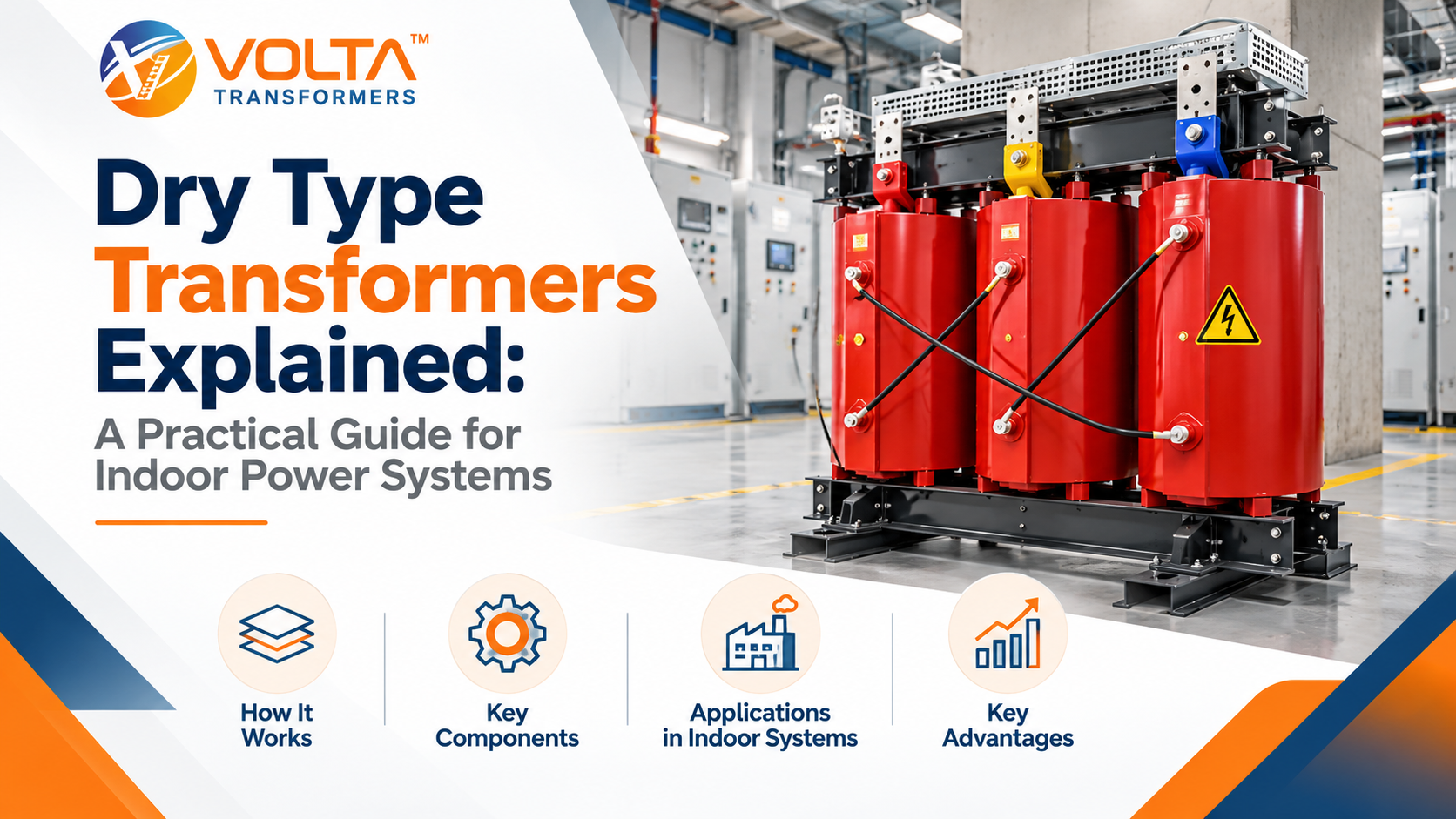
Picture the electrical room in a hospital basement. It sits under patient wards, close to the people who depend on it, and there is very little space to spare. Whatever transformer goes in there has to run for years without drama, fit the room, and avoid adding fire or spill risks to a building full of people. That is exactly the kind of situation where dry type transformers come up in conversation.
Transformer selection shapes safety, uptime, floor space and the maintenance load your team carries for decades. This guide therefore explains what dry type transformers are, how they work, where they fit, how they compare with oil-filled units, and what to check before you specify one. It is general technical education, so always have a qualified electrical engineer confirm the final sizing and specification.
What Are Dry Type Transformers?
A dry type transformer is a transformer whose core and windings use air for cooling instead of sitting in insulating oil. Solid materials, such as varnish-impregnated insulation or cast resin, insulate the windings, while the surrounding air carries the heat away.
Like every transformer, it transfers energy between circuits by electromagnetic induction, with no direct electrical connection between the primary and secondary sides. In other words, what sets it apart from a liquid-filled transformer is the insulation and cooling medium, not the basic principle.
Neither design is better in every situation. Oil-filled units are common outdoors and at high capacities. By contrast, designers often choose dry type transformers where fire safety, indoor placement and low upkeep carry the most weight.
Cast Resin vs VPI Dry Type Transformers
Dry type designs mainly differ in how they insulate the windings:
- Cast resin: Epoxy resin fully encapsulates the windings, which seals them against moisture and dust.
- VPI (vacuum pressure impregnated): The manufacturer impregnates the windings with varnish under vacuum and pressure, which leaves them more open to the air.
Each type suits different environments and budgets, so ask the manufacturer which insulation system a particular design uses.
How Do Dry Type Transformers Work?
Three parts do the main work. First, the primary winding receives the incoming supply and sets up an alternating magnetic flux in the core. The laminated steel core then guides that flux. Finally, the secondary winding, linked to the same flux, delivers the output voltage. The ratio of turns between the two windings decides whether the transformer steps voltage down or up.
Heat is the by-product. Core losses (from magnetising the steel) and winding losses (from current flowing through the conductors) both turn into heat. As a result, the design has to shed that heat to protect the insulation.
With air natural (AN) cooling, heat leaves by natural convection around the core, coils and enclosure. With air natural / air forced (ANAF) arrangements, fans can also add airflow when the load rises, where the design allows. Consequently, room ventilation becomes part of the transformer’s cooling system rather than an afterthought.
Advantages of Dry Type Transformers
Fire Safety
With no flammable insulating oil, there is no oil to ignite or feed a fire inside the room. This lowers the fire load, which is why dry type transformers are a common choice for indoor sites. However, it doesn’t remove electrical fire risk altogether. Overloaded windings, loose connections and blocked ventilation can still cause failures, so proper protection and good practice still apply.
Lower Routine Maintenance Needs
Liquid-filled designs call for oil sampling, top-ups and leak checks. A dry type unit, on the other hand, skips all of that. It still needs scheduled inspection, but the routine is lighter.
Environmental Considerations
Without insulating liquid, there is no oil leak to contaminate soil or water. In some projects, that can also simplify containment arrangements. Still, local regulations vary, so check what applies to your site.
Space and Installation Flexibility
Compact designs suit space-constrained buildings such as high-rises, hospitals and shopping malls. In practice, though, suitability depends on ventilation, access, clearances and enclosure requirements. After all, a dry type unit still needs air around it to do its job.
Energy Efficiency
Efficiency comes down to core (no-load) losses and winding (load) losses. Since performance varies by design, compare the rated loss figures on each datasheet at the loading you expect. For example, no-load losses dominate in a transformer that runs lightly for most of the day, which changes the maths. Our article on ways to reduce transformer losses in industrial plants covers this in more detail.
Where Are Dry Type Transformers Used?
You’ll find dry type transformers in many indoor settings:
- Commercial buildings and office complexes
- Hospitals and healthcare facilities
- Shopping malls, hotels and educational institutions
- Manufacturing plants and industrial facilities
- Data centres and other critical-load facilities, where the design is appropriate
- Indoor electrical distribution rooms and selected substation installations
What these sites share is a need for safe, dependable power close to people and equipment. However, building type alone doesn’t decide suitability. A hospital wing and a manufacturing plant may both use dry type units, yet their electrical rating, ambient conditions, load profile and installation requirements can differ a great deal.
Understanding Different Dry Type Transformer Applications
The three terms below describe the application and installation context. They are not separate, mutually exclusive designs, so a single unit can fit more than one label.
Indoor Dry Type Transformer
An indoor dry type transformer sits inside a building, typically in an electrical room, plant room, basement or dedicated transformer bay. Here, the surroundings matter as much as the unit. Check the ambient temperature, ventilation, humidity and dust levels. Dust can clog cooling paths, while moisture can degrade insulation, so the enclosure rating should suit the room. In addition, leave enough space for safe inspection and access.
Dry Type Distribution Transformer
A dry type distribution transformer steps voltage down to the level that downstream equipment uses. It feeds distribution boards, motor control centres, lighting and general building loads, much like an oil-filled distribution transformer does outdoors.
Dry Type Substation Transformer
A dry type substation transformer can form part of an indoor substation or a compact substation, often alongside medium-voltage switchgear and low-voltage panels. Whether it suits a given project depends on the voltage class, capacity, protection, enclosure and project specification.
Dry Type vs. Oil-Filled Transformers
Factor | Dry Type | Oil-Filled |
Insulation and cooling | Solid insulation, air cooling | Insulating oil for insulation and cooling |
Fire and leakage | No flammable liquid, no oil leakage | Oil is flammable and needs leak management |
Routine maintenance | Inspection of connections, insulation and cooling paths | Adds oil sampling, testing and top-ups |
Indoor suitability | Often well suited, subject to ventilation and clearances | Possible with added fire and containment measures |
Environmental considerations | No oil spill risk | Needs containment and spill planning |
Installation requirements | Airflow, clearances, enclosure protection | Containment, fire protection and oil handling |
Lifecycle cost factors | Purchase price, losses, ventilation, maintenance | Purchase price, losses, oil upkeep, civil works |
This is a balanced picture. Oil-filled transformers may suit outdoor, high-capacity or project-specific requirements, and they remain a sound choice in many of them. Dry type transformers, meanwhile, can be the stronger fit for suitable indoor applications. Total lifecycle cost depends on your load, your site and local rules, so avoid assuming that either option always costs less. For a deeper comparison, see our guide to dry type vs oil-filled transformers.
How to Choose the Right Dry Type Transformer
Selecting the right transformer for your facility is easier when you work through the key factors. Use this checklist as a starting point:
- Capacity: Confirm the required kVA or MVA rating.
- Voltage ratings: Define the primary and secondary voltages.
- Load demand: Consider the current load and expected future growth.
- Cooling and ventilation: Decide between natural and forced air, and check that the room can support it.
- Environment: Review the indoor ambient temperature, humidity, dust and other conditions.
- Insulation and thermal performance: Check the insulation system, insulation class (for example, F or H) and rated temperature rise.
- Standards: Align with the applicable electrical standards and project specifications.
- Protection and enclosure: Plan the protection, earthing, enclosure type and installation clearances.
- Noise, access and upkeep: Think about sound levels, access routes and maintenance needs.
- Lifecycle cost: Weigh future expansion and long-term operating costs, not just the purchase price.
Finally, have a qualified electrical engineer confirm the sizing and specification using actual project data.
Installation and Maintenance Considerations
A good installation starts with a suitable, level location. Follow the manufacturer’s ventilation and clearance requirements, and protect the unit from moisture, dust and foreign objects. Electrical connections, earthing and protective devices also need correct installation.
Once the unit is in service, periodic inspections should cover connections, insulation condition, cooling paths and operating temperatures. Maintain the unit according to the manufacturer’s instructions and applicable safety procedures. Because installation, testing and maintenance involve live and potentially lethal voltages, only qualified personnel should carry them out.
Why Consider Volta Transformers for Dry Type Transformers?
Volta Transformers manufactures dry type transformers from 100 kVA to 4 MVA. High-voltage classes run from 1.1 kV to 34.5 kV, and low-voltage classes include 380 V, 400 V, 415 V, 433 V, 440 V and 600 V, with customised classes available on request. Cooling options are AN and ANAF.
The range also offers two tap-changer options. An OCTC (off-circuit tap changer) adjusts the voltage ratio while the transformer is de-energised, whereas an OLTC (on-load tap changer) adjusts it while the transformer is in service. The right configuration depends on your project’s voltage, capacity, operating environment and technical specification.
Conclusion
In the right indoor setting, dry type transformers offer a practical mix of fire-conscious design, low routine maintenance and freedom from oil-leak concerns. Even so, they aren’t automatically the answer for every project. Load requirements, ventilation, efficiency and long-term maintenance planning should drive the decision, with oil-filled alternatives weighed fairly where they fit better.
Frequently Asked Questions
What is the difference between a dry type distribution transformer and an oil-filled transformer?
The main difference is insulation and cooling. A dry type unit uses solid insulation and air cooling, while an oil-filled unit uses insulating oil. As a result, the two differ in fire and leakage risk, maintenance and placement. Neither is better in every case, so project conditions decide.
Where is an indoor dry type transformer typically installed?
It usually sits in an electrical room, basement, plant room or dedicated substation bay inside a building. The location needs adequate ventilation, clearance for airflow and access, protection from moisture and dust, and a level, stable base.
What is a dry type substation transformer?
It is a dry type unit that steps medium voltage down for distribution within an indoor or compact substation, usually alongside switchgear and low-voltage panels. Suitability depends on the voltage class, capacity, protection, enclosure and project requirements.
What is the difference between cast resin and VPI dry type transformers?
Cast resin designs fully encapsulate the windings in epoxy, which seals them against moisture and dust. VPI designs, by contrast, impregnate the windings with varnish under vacuum and pressure. The right choice depends on the environment, rating and budget.
What maintenance do dry type transformers require?
Maintenance is mostly inspection-based: checking connections, insulation condition, cooling paths and operating temperature, and removing dust. There is no oil to sample or top up. However, follow the manufacturer’s instructions, and have qualified personnel do the work under proper isolation procedures.
How do you select the right dry type transformer capacity?
Start with the connected load and apply realistic demand factors. Then add a margin for expected growth and any overload needs. Next, match the result to a standard kVA rating and confirm the cooling and ambient conditions. Finally, have a qualified engineer verify the size.

Leave a Comment