

Reliable power distribution depends on equipment that sits close to the load, stays safe around people, and keeps working outdoors for years. So, what is a pad-mounted transformer, and why is it so common wherever cables run underground? It is a distribution transformer housed in a locked, tamper-resistant steel enclosure and installed at ground level on a concrete pad. It steps medium voltage down to a level that buildings, plants and equipment can use.
This guide covers how these transformers work, what’s inside them, where they’re used, how they compare with pole-mounted units, and what to check before you select one.
What Is a Pad-Mounted Transformer?
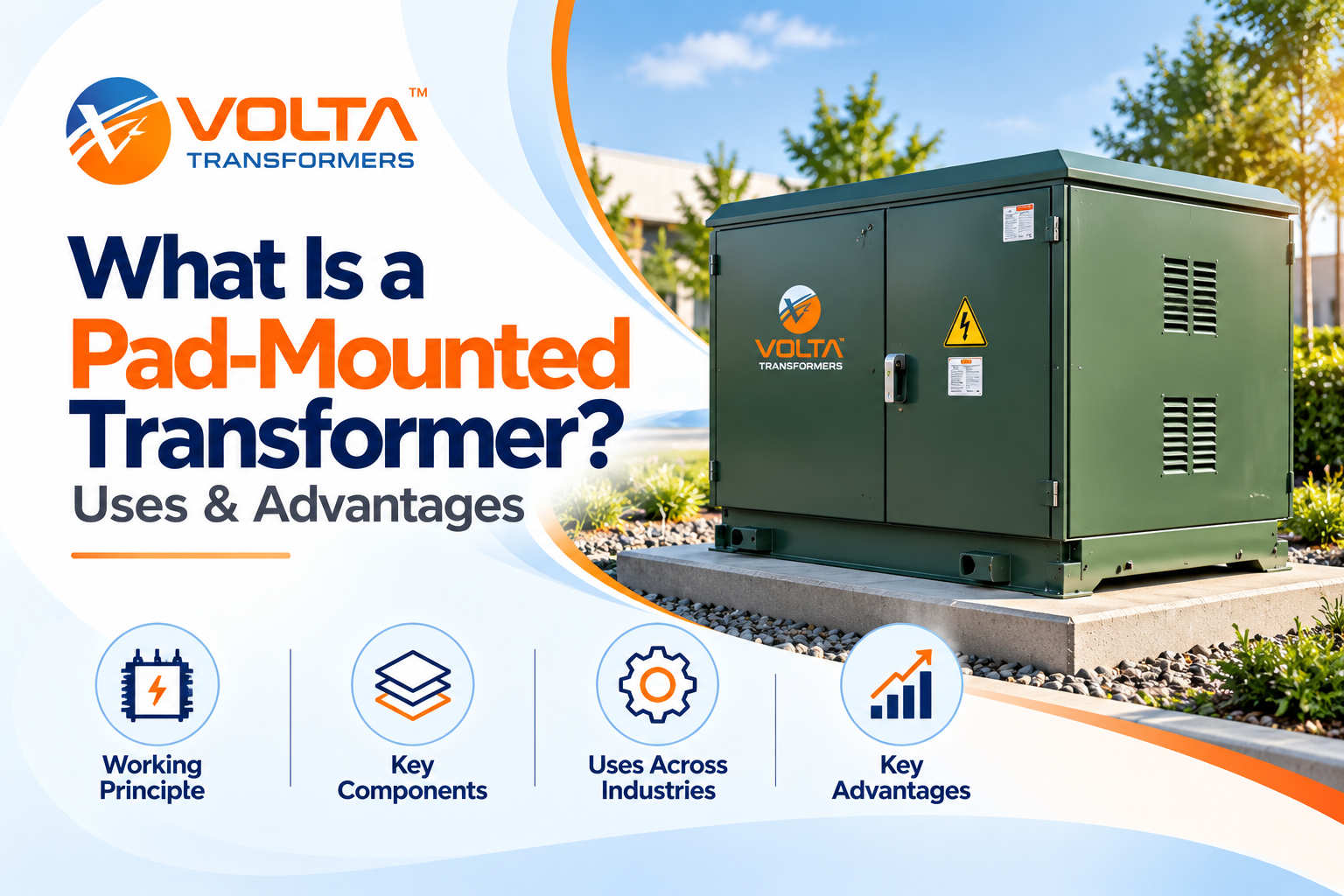
A pad-mounted transformer is a ground-level distribution transformer. Its core, windings and insulating liquid sit in a sealed tank, and that tank sits inside a lockable cabinet with separate compartments for high-voltage and low-voltage cable connections. Because the incoming cables run underground, there are no overhead lines at the installation point.
Two features define the design. The first is the enclosure, which keeps live parts away from the public and protects the equipment from rain, dust and tampering. The second is the cable arrangement: medium-voltage cables enter from below, and low-voltage cables leave the same way. By contrast, a pole-mounted transformer hangs from a utility pole and connects to overhead conductors.
How Does a Pad-Mounted Transformer Work?
Like any other transformer, it works on electromagnetic induction. Alternating current in the primary winding creates an alternating magnetic flux in the core. That flux then links the secondary winding and induces a voltage in it. The turns ratio between the two windings sets the ratio between input and output voltage. In other words, the transformer doesn’t generate power; it simply changes the voltage at which it delivers the same power.
In service, the sequence looks like this:
- Supply arrives. The underground medium-voltage cable terminates in the high-voltage compartment through bushings or separable connectors.
- Switching and protection act. Depending on the design, a switch and fuses connect the supply to the transformer and isolate it if a fault occurs.
- The primary winding energises. Current in the primary produces an alternating flux in the laminated steel core.
- The secondary produces a lower voltage. The turns ratio sets the output. For example, a 13.2 kV primary and a 415 V secondary give a line-voltage reduction of roughly 32 to 1.
- The liquid removes heat. Losses in the core and windings warm the insulating liquid, which carries the heat to the tank surface. From there, it dissipates into the surrounding air.
- Power leaves at low voltage. Finally, cables in the low-voltage compartment carry the output to a main panel, switchgear or distribution board.
Pad-Mounted Transformer Components
Pad-mounted transformer components vary with the manufacturer, voltage class and project specification. Therefore, treat the list below as typical rather than universal.
- Core: Stacked laminations of electrical steel provide a low-reluctance path for the magnetic flux. In addition, lamination limits eddy-current losses.
- Primary and secondary windings: Insulated copper or aluminium conductors wrap around the core.
- Tank: A sealed steel vessel holds the core, windings and insulating liquid, much like a hermetically sealed transformer. Radiators or corrugated walls also increase the surface area for cooling.
- Insulating liquid: The liquid insulates the windings and carries heat away. Mineral oil is common, although some specifications call for other fluids.
- Enclosure: A weather-resistant, lockable cabinet houses the compartments. For coastal, humid or industrial sites, a corrosion-resistant finish matters.
- High-voltage compartment: This holds the primary bushings, cable terminations and often the switch and fuses. Designs are either dead-front (shielded, touch-safe connectors) or live-front (exposed bushings, which typically need greater clearances). They also come as radial feed, with one incoming cable, or loop feed, with two cable connections so the supply can continue around a ring if you isolate one section.
- Low-voltage compartment: This holds the secondary bushings or terminals where the outgoing cables connect.
- Switching and protection devices: Depending on the model, these can include load-break switches, fuses, surge arresters, a pressure relief device, and temperature or liquid-level indicators.
- Tap changer: An off-circuit tap changer commonly adjusts the voltage ratio in small steps. However, check the model specification.
- Earthing: Earthing points on the tank and compartments keep fault current on a safe path.
- Cable connections: Bushings, elbows and lugs connect the transformer to the underground cable system.
Pad-Mounted Transformer Applications
Pad-mounted transformer applications cover most places where power arrives by underground cable and needs stepping down near the load.
- Industrial plants: Steel, cement, petrochemical, automotive, pharmaceutical and textile facilities use them to feed motors, process lines and plant distribution boards. Ground-level units can also sit near the load centre inside the plant boundary.
- Commercial buildings: Malls, hotels and high-rise buildings often prefer cable-fed, enclosed equipment that isn’t visible overhead.
- Residential developments: Housing societies and residential towers with underground networks use them to avoid overhead conductors.
- Hospitals and institutions: Locked enclosures keep equipment out of public reach, which suits sites with many visitors. Critical facilities, however, also need redundancy and backup supply beyond the transformer itself.
- Renewable energy projects: Solar, wind and hydro projects use pad-mounted designs for collection and step-up or step-down duty. Plants with inverters, though, usually need transformers built for harmonic and cyclic loading, such as solar and wind inverter duty transformers.
- Infrastructure projects: Tunnels, highways and construction sites often need temporary or permanent supply that is compact, enclosed and cable-connected.
Pad-mounted units also serve oil and gas plants, refineries, mining and heavy industry.
What Are the Advantages of a Pad-Mounted Transformer?
How much each advantage matters depends on the installation, the design and the operating environment.
- Controlled access: A locked, tamper-resistant enclosure separates the public from live parts. In addition, you access the high-voltage and low-voltage compartments separately.
- Fit with underground distribution: Cables enter and leave below ground, so the transformer can terminate an underground feeder directly without overhead lines or poles.
- Visual integration: A low-profile cabinet is less intrusive than overhead equipment, and it can sit close to the load, subject to clearance and safety rules.
- Outdoor suitability: A sealed tank and weather-resistant cabinet allow outdoor installation. Still, check the site for climate, humidity, flooding risk and corrosion.
- Capacity options: Pad-mounted transformers come in a wide range of ratings, so one design family can cover small commercial loads through to large industrial ones.
- Easier inspection: Ground-level access makes inspection straightforward, and a sealed, liquid-filled design suits routine checks of liquid level, temperature and connections. Even so, maintenance still needs planning, including clearance, safe isolation and periodic testing.
However, pad-mounted units also need a foundation, working clearances and adequate drainage. As a result, ground space and site preparation count against them in tight locations. Where space is very limited, a compact substation, which packs switchgear, a transformer and an LV panel into one enclosure, may be worth comparing.
Pad-Mounted Transformer vs. Pole-Mounted Transformer
Feature | Pad-Mounted Transformer | Pole-Mounted Transformer |
Installation | Ground level, on a concrete pad | Elevated on a utility pole |
Enclosure | Lockable steel cabinet around compartments | Typically an exposed tank with bushings, mounted overhead |
Cable arrangement | Underground cables | Overhead conductors |
Typical applications | Underground networks; commercial, industrial and institutional sites | Overhead networks; rural and suburban feeders |
Space requirement | Needs ground space, a foundation and clearances | Uses no ground space, but needs a suitable pole structure |
Maintenance access | Ground-level access, with working clearance | Elevated work, often needing a bucket truck or climbing |
Neither option is better in every case. Instead, the right choice depends on the existing network, local regulations, load size and site constraints. For a broader comparison, see our guide to types of transformers based on application.
How to Choose the Right Pad-Mounted Transformer
The final selection follows from the project’s electrical design. Still, these are the usual checkpoints:
- Load calculation: Add up the connected loads, apply demand and diversity factors, and allow for future growth. Undersizing causes overheating, while oversizing wastes money and raises no-load losses.
- kVA capacity: Then choose a standard rating that covers the calculated load with a margin.
- Primary and secondary voltage: Match the supply voltage and the load voltage.
- Phase and frequency: Confirm three-phase or single-phase and the system frequency before you order.
- Winding material: Copper and aluminium differ in conductivity, weight and cost.
- Cooling method: Liquid-filled units commonly use ONAN (oil natural, air natural) cooling.
- Environmental conditions: Check the ambient temperature, altitude, humidity, dust, coastal salt and flood risk.
- Protection: Decide which switching, fusing, surge protection and monitoring devices the installation needs.
- Applicable standards: Specify the standards the manufacturer must test the transformer against, such as IEC, IEEE or Indian Standards, depending on the project.
- Losses and maintenance: Finally, compare lifetime cost, not just purchase price, and plan how you’ll inspect the unit. Our article on ways to reduce transformer losses in industrial plants covers practical steps.
Why Consider Volta Transformers for Pad-Mounted Transformers?
Volta Transformers manufactures liquid-filled, three-phase pad-mounted transformers from 100 kVA to 5,000 kVA. High-voltage classes include 12.47, 13.2, 13.8 and 34.5 kV, and low-voltage classes range from 380 V to 690 V, with ONAN cooling. The range also offers copper or aluminium windings, corrosion-resistant and tamper-proof enclosures, and customised capacities and voltage ratings for different projects.
Details such as protection devices, standards and enclosure arrangement vary by model. Therefore, request datasheets for the exact configuration you need, and confirm them with the Volta team against your project specification.
Conclusion
A pad-mounted transformer brings medium voltage down to a usable level at ground level, in a secure enclosure fed by underground cable. It suits industrial plants, commercial buildings, residential developments, hospitals, renewable projects and infrastructure work. In addition, it offers clear advantages in access control, fit with underground networks and outdoor durability. Put simply, it answers one question: how to supply power safely where overhead lines are not an option. The right unit, however, depends on your load, voltage, site and protection requirements.
What is a pad-mounted transformer used for?
It steps medium-voltage power from an underground cable down to a lower voltage for commercial, industrial, institutional and residential loads. It sits at ground level inside a locked enclosure.
What are the main pad-mounted transformer components?
The main components are the core, primary and secondary windings, tank, insulating liquid, enclosure, high-voltage and low-voltage compartments, switching and protection devices, earthing and cable connections. However, exact configurations vary by design.
What are the major pad-mounted transformer applications?
They include industrial plants, commercial buildings, residential developments, hospitals, renewable energy projects, and infrastructure such as tunnels and highways.
How does a pad-mounted transformer reduce voltage?
The primary winding has more turns than the secondary. As a result, induction through the core produces a lower voltage in the secondary, in proportion to the turns ratio.
Are pad-mounted transformers suitable for outdoor installation?
Yes. Manufacturers design them for outdoor use, with sealed tanks and weather-resistant enclosures. Still, check site conditions such as flooding, heavy corrosion or extreme temperature against the specification.
What is the difference between dead-front and live-front designs?
A dead-front design uses shielded, touch-safe connectors, so you won’t find exposed live parts when you open the HV compartment. A live-front design, by contrast, has exposed bushings and usually needs greater clearances.
What is the difference between pad-mounted and pole-mounted transformers?
A pad-mounted transformer sits on a ground-level concrete pad inside a locked cabinet and connects to underground cables. A pole-mounted transformer, on the other hand, hangs from a pole and connects to overhead lines.
What factors determine the capacity of a pad-mounted transformer?
Capacity depends on the connected load, demand and diversity factors, load type, expected growth and operating conditions. You then round the result up to a standard kVA rating.
Which cooling method do pad-mounted transformers use?
Liquid-filled units commonly use ONAN cooling, where natural circulation of the insulating liquid and natural airflow remove heat.
How do you maintain a pad-mounted transformer?
Routine work includes visual inspection of the enclosure and bushings, checks of liquid level and temperature, tightness of connections, earthing checks and periodic electrical testing. Only qualified personnel should carry out this work, with the unit isolated.

Leave a Comment